Nearly 4 in 10 mothers (39%) say a child needed support for a mental, emotional, or behavioral concern in the past 12 months, and 53% are at least moderately worried about their children’s mental health.
- Financial stress is mothers’ top concern. Asked in their own words about the biggest concern for their family’s wellbeing, 41% of mothers who named a specific concern named financial stress, more than three times the next theme.
- Half of mothers found their own mental health difficult to care for. 50% say taking care of their own mental health was difficult in the past 30 days. Among those mothers, time is the obstacle named first (49%), about three times cost (16%).
- A child needing help shows up in the mother. The 50% rises to 70% among mothers whose child needed support, and to 78% where the support came only after significant barriers.
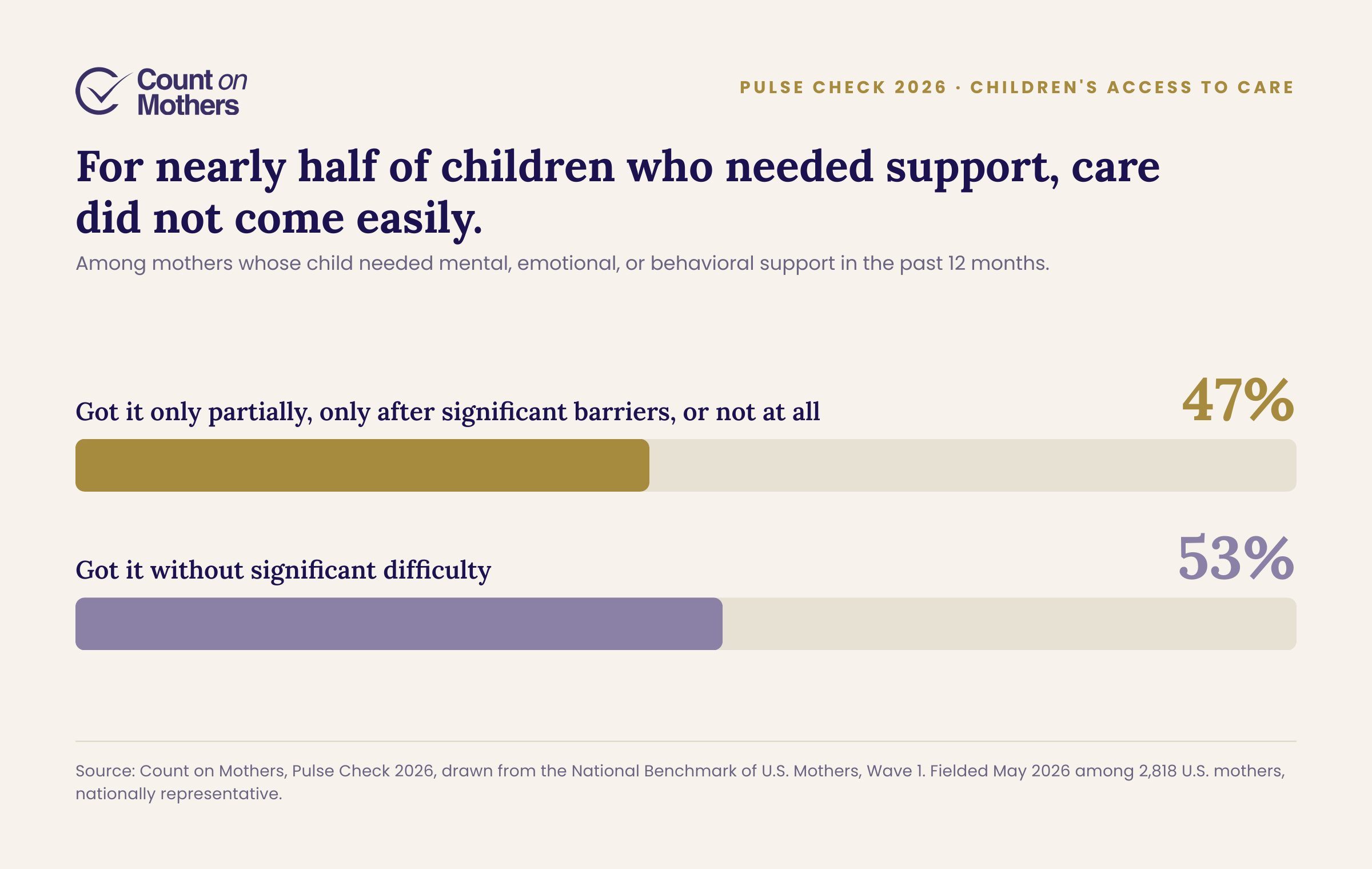
- Getting care is hard for nearly half. Among mothers whose child needed support, 47% got it only partially, only after significant barriers, or not at all. The other 53% got it without significant difficulty.
- Insurance barriers are common. Among mothers whose child needed support, 56% ran into at least one insurance problem, most often no in-network provider, a prior-authorization delay, or a limit on covered visits, and 34% ran into two or more.
- Cost keeps families from care at every income level. 44% of mothers delayed or avoided care because of cost in the past year. Delays in a mother’s own care peak in the middle incomes, 53% at $50,000 to $74,999, above both the lowest-income group (38%) and $200,000 or more (35%).
- Schools are trusted first and hard to reach. Mothers place schools first of the eleven institutions measured, and 45% of those who rated school access report difficulty reaching a counselor or mental health professional there.
- Mothers across the political spectrum want a legal duty on the companies. 77% support a law requiring social media platforms and AI companies to take reasonable steps to protect children and teens, a majority in every political group. 65% report little or no trust in AI companies to act in the best interests of children and families.
Source: Count on Mothers, Pulse Check 2026: Mothers on mental health, getting care, and the systems around their families, October 2026. Findings draw on Wave 1 of the National Benchmark of U.S. Mothers, a survey of 2,818 U.S. mothers conducted May 7 to 27, 2026, on a national online opt-in panel blended with The Count, Count on Mothers’ community panel. Results are weighted to U.S. Census benchmarks on region, race and ethnicity, education, household income, and the mother’s age. The margin of error is plus or minus 2.3 percentage points, computed on the design-adjusted effective sample; margins for subgroups are larger. Inseparable commissioned the report, identified the subject areas examined in depth, underwrote the rotating module items, and received findings in advance, with no editorial role. Count on Mothers designed and wrote the instrument, conducted the analysis, and decided what to publish. Research led by Jennifer Brailsford, PhD, Director of Research, and Melissa Lawrence, MPH, MS, Director of Data Science. Full methodology at countonmothers.org/methodology.